
Building the New Art Lifestyle
A New York City Pilot to Prove Masterworks’ Next Brand Evolution
Summary
Masterworks has done something extraordinary: it democratized access to blue-chip art investment, built a platform with over one million members, amassed $941 million in assets under management, and achieved a 100% positive exit rate across 23 sold artworks. That track record is a genuine competitive moat.
But there is a generation of people — late 30s, early 40s, newly wealthy, culturally fluent — for whom Masterworks could be something more than an investment platform. For them, it could be the community that defines what it means to arrive. The brand that signals taste, access, and belonging at the exact moment they are building their adult identity. And once they are inside that community, the portfolio follows naturally — not because someone pitched them, but because investing through Masterworks becomes the obvious next step in a relationship they already value.
That is a brand evolution, not just a market expansion. And a single party in New York is the fastest way to prove it is real.
Together, we could show that the most powerful version of Masterworks is not a platform people invest through — it’s a world people want to belong to. One night in New York, with the right room, could be the proof of concept for that next chapter.
The ask is not a multi-city rollout or a rebrand. It is a pilot — a genuinely great party, the right 75 people, a professional content team, and a funnel that captures everything that happens after. If the room is right and the content lands, Masterworks will see immediately whether this brand evolution is worth building at scale.
The Market Gap
Who Masterworks Reaches Today
Masterworks’ current marketing — targeted ads, financial content, SEC filing language — speaks fluently to one audience: the finance-and-business professional, 40s to 60s, who already thinks in terms of asset allocation and portfolio diversification. This is a strong audience. But it is not the fastest-growing one.
Masterworks’ events reinforce this. In September 2025, Masterworks hosted a private Christie’s tour in New York — members exploring auction lots with a Post-War and Contemporary Art expert, learning about Joan Mitchell, Warhol, and Hernan Bas. A genuinely well-executed experience.
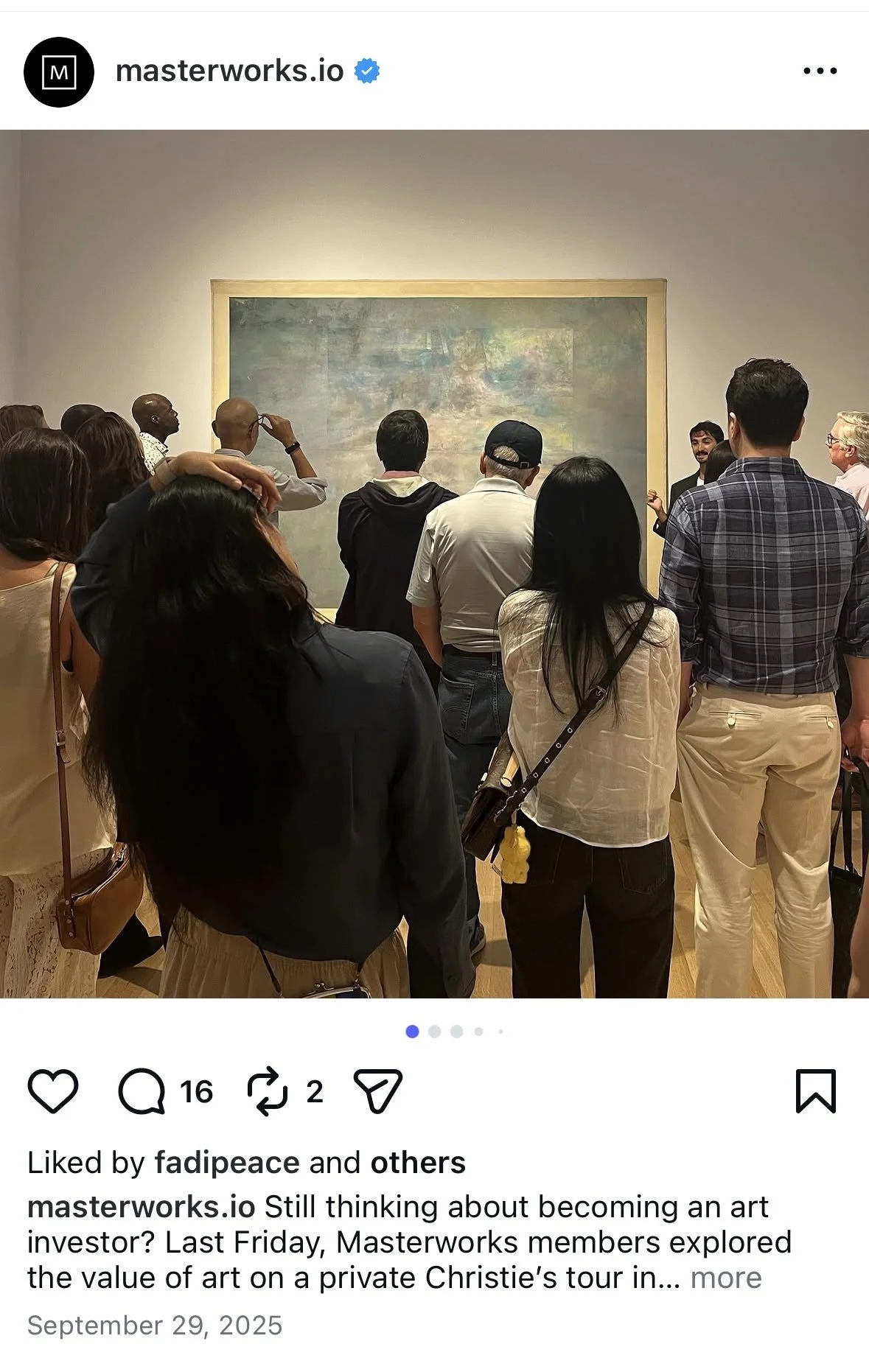
That kind of event does something valuable: it builds confidence. It gives someone who is already interested in Masterworks a reason to feel informed before they invest. It engages the rational brain — the part that reads prospectuses, asks questions, and evaluates track records.
But it only works on people who were already close to a yes. It does not recruit the unconverted. It does not create FOMO. It does not make someone who had never thought about art investment suddenly feel like they are missing out on something their peers are part of.
FOMO is a stronger conversion driver than returns. The Christie’s tour confirms the decision. The party creates it.
Who Masterworks Doesn’t Reach
There is a second accredited investor cohort — different in background, identity, and values — that Masterworks has not meaningfully addressed. They are roughly 30 to 45 years old. They work in tech, media, design, startups, and the creative industries. Many of them achieved accredited status through equity compensation, founder exits, or rapid career acceleration rather than through traditional finance paths.
They are not looking for a Barron’s-style brand. They want to invest alongside people who share their taste. They follow artists on Instagram. They go to gallery shows not because they have to, but because they want to. Art is already part of their identity — Masterworks just hasn’t shown up in their world yet.
| Segment | Est. NYC Size | MW Penetration | Soho House Overlap |
|---|---|---|---|
| Finance / PE / hedge fund (35–45) | 30,000–40,000 | Medium | Low |
| Tech / startup / equity-comp wealth | 25,000–35,000 | Very low | Medium–High |
| Creative entrepreneurs (media, design, agency) | 15,000–25,000 | Near zero | Very high |
| Corporate executives (non-finance) | 20,000–30,000 | Low | Low–Medium |
| Doctors / lawyers / professionals | 20,000–30,000 | Low | Low |
The tech and creative segments — roughly 40,000 to 60,000 accredited or near-accredited individuals in New York alone — represent the whitespace. These are people who are culturally receptive to art, financially capable of investing, and almost entirely absent from Masterworks’ current base. They are not being reached because Masterworks has never shown up in a context that speaks to them.
Masterworks doesn’t have a product problem in this market. It has a discovery problem. These people just haven’t been invited into the right room yet.
The Audience: New York’s Creative Wealth Class
The target guest for the New York pilot is a specific person, not a demographic abstraction. Here is who they are:
Age 32–45. Late millennial or early Gen X. Accredited or approaching it.
Works in tech, venture, media, design, fashion, agency, or a high-growth startup.
Has a Soho House membership, goes to gallery openings, follows artists and curators on Instagram.
Invests — probably in index funds, maybe in crypto — but has never thought of art as an investable asset class.
Makes financial decisions based on what their peer group is doing. Highly influenced by in-person experiences.
Does not respond to traditional financial advertising. Responds to things that feel like a recommendation from someone they respect.
This person is not hard to find in New York. They are at every opening at Pace, Hauser & Wirth, and Fotografiska. They are the people in the room at every interesting dinner. They have the money and the taste. What they lack is someone making the connection between what they love and what they could own.
That is exactly the gap this event is designed to close.
The New York Pilot
Why a Party, Not a Tour
Masterworks’ website currently runs lines like “Investing in Art Could Be the Best Opportunity Since the Financial Crisis.” That headline is aimed squarely at the rational brain. It says: here is a financial argument, evaluate it.
That framing is not wrong for the audience Masterworks already has. But it is completely wrong for the audience this pilot is trying to reach. The 38-year-old creative director with a Soho House membership and $800K in unvested RSUs does not make investment decisions by evaluating crisis-era market comparisons. She decides based on what her friends are excited about. She decides based on what feels like the room she wants to be in.
Art should not be intellectualized at the point of introduction. It should be felt. The whole reason art has cultural power is that it bypasses the reasoning mind entirely — it creates an immediate emotional response before anyone has formed a considered opinion. A great event does the same thing. You walk in, the music is right, the space is right, the people are the ones you want to know, and there is something extraordinary on the wall. You don’t think about whether art is a good investment. You think: I want to be in this world.
The line isn’t “Investing in art could be the best opportunity since the financial crisis.” The line is: “investing in art might be the most fun you’ve ever had with your money.” That’s a different person, a different moment, and a different conversion entirely.
The party creates that moment. The Christie’s tour deepens it. Both have a role — but the party has to come first for this audience.
The Event
One evening. Seventy-five people. A venue that signals taste — a private gallery, a Tribeca loft, a raw industrial space with something extraordinary on the walls. Not a hotel ballroom. Not a conference room. Not a networking event.
This is a party. That is the entire brief. Great music — a DJ who sets the right tone, or a live performance if the space calls for it. Real food and drinks, not passed canapés and warm white wine. The kind of evening where people stay two hours longer than they planned because they are genuinely enjoying themselves.
The art is the backdrop, not the program. Masterworks pieces — or works from artists in their collection universe — are on the walls and available to look at, but no one is giving a lecture. The room should feel like someone with extraordinary taste and access threw a party for people they actually wanted in the room.
There is one optional moment of light programming: a Masterworks team member can do five minutes of honest, casual conversation — not a pitch, more like a founder talking to friends about what they’ve built. Something that feels like “if you’re curious, here’s what’s actually going on’” rather than a presentation. Then the music comes back up.
Guests know they are being introduced to something interesting. They do not feel sold to. The goal is that they leave thinking: that was the best party I’ve been to in months, and also, I need to find out more about Masterworks.
The Guest List
This is where I add the most direct value. I have existing relationships across the New York creative, tech, and media community — the Soho House-adjacent world of founders, directors, designers, editors, and operators in their 30s and 40s who fit this profile precisely.
I can bring on collaborators who extend that reach: people with curated lists inside the fashion and art world, the startup and VC community, the media and agency space. Together, we can build a room of 75 people where most guests arrive through a personal connection rather than a generic invite. That changes the energy of the evening entirely.
The rule: every guest should feel like they were specifically chosen. Because they were.
The Content Play
A professional photographer and a small video team are present for the entire evening. The goal is not event documentation. The goal is aspirational editorial content — the kind of imagery that makes people who weren’t there wish they had been.
Specific content captured:
Short video interviews (60–90 seconds) with 4–6 guests: “How did you first get into collecting?” “What’s the first piece you bought?” “What does art mean in your life?” Genuine answers, not scripted. These become the most shareable content.
Editorial photography of the room, the work, the conversations — lit and framed for LinkedIn and Instagram, not for a press release.
A 90-second event recap reel for organic LinkedIn posting.
Masterworks’ team present for natural, photographed conversations — not staged product moments.
This content serves multiple functions simultaneously: it gives Masterworks a week of social content from a single evening; it gives guests a reason to share (people post things that make them look interesting); and it creates a documented artifact that future guests can reference when deciding whether to attend the next one.
The event is one night. The content from it lasts six months. Every post is a proof of concept that Masterworks belongs in this world.
What Happens After the Room
Lead Capture
A QR code at the entrance — simple, tasteful, framed as joining the Masterworks community rather than filling out a form. Guests register with name, email, and one qualifying question: are you an accredited investor?
Seventy-five guests at 60–80% scan rate yields 45–60 qualified contacts from a single evening. More importantly, these are warm contacts who were personally invited and showed up — a very different signal than a digital lead.
CRM Routing
Lead routing is automatic and immediate:
Accredited investors → Sales + Membership Track: personalized outreach, exclusive content, escalating access, direct path to Masterworks membership.
Non-accredited → Nurture Track: editorial relationship maintained through content, event invitations, and re-qualification checks until they cross the threshold.
The accredited track moves quickly. Day 1 is a personal email — not a drip sequence, a note that references the evening and feels like it came from a person. Day 3 is a text. Day 7 is a market insight that demonstrates Masterworks knows what they are talking about. Day 14 is the first soft mention of membership. Day 21 is a personal call.
The nurture track moves slowly and keeps the brand warm. Monthly editorial content, quarterly event recaps, annual re-qualification. The goal is that by the time someone reaches accredited status, Masterworks is already the obvious choice.
What This Could Become
| Pilot | Month 1–2 | NYC Proof of Concept | 1 curated party, 75 guests, DJ/live music, professional content team, CRM live. Prove the audience exists and converts. |
| Phase 2 | Months 3–12 | NYC at Scale + 1 New City | Quarterly NYC events. Add Miami or LA. Build the recurring community. Target: 2,500 leads, 250 accredited members. |
| Phase 3 | Year 2+ | The Annual Summit | A flagship Masterworks cultural moment — part Dreamforce, part Art Basel. The event that defines wealth culture for the next generation. |
The pilot is deliberately small so that the signal is clean. If 75 of the right people show up, engage, and a meaningful percentage convert — that is proof of concept that scales. If something is off, we learn it cheaply and adjust. The ask at the pilot stage is not a budget commitment to a global rebrand. It is one evening in New York.
The Invitation
Masterworks has already built something genuinely rare: a platform with real returns, a real track record, and a brand that means something. The next stage is not more of the same. It is expanding what the brand can mean — from a platform people invest through to a community people want to belong to, one where the investing feels like a natural expression of membership rather than the point of entry.
A party in New York, with the right 75 people, is the lowest-risk way to find out whether that evolution is real. The room either has it or it doesn’t. The content either travels or it doesn’t. The leads either convert or they don’t. Everything is measurable, and the downside is one evening.
The most powerful version of Masterworks is a world people want to belong to — where the art on the wall and the investment in the portfolio are two expressions of the same identity. One party in New York could be the first proof that version exists.
Contact: michael@ops.house
